Polygon Angle Master

1. The Interior Angle Sum

Every polygon can be divided into triangles by drawing diagonals from a single vertex. Since the sum of interior angles in any triangle is always 180°, we can calculate the total sum for any polygon by multiplying the number of triangles it can contain by 180°.
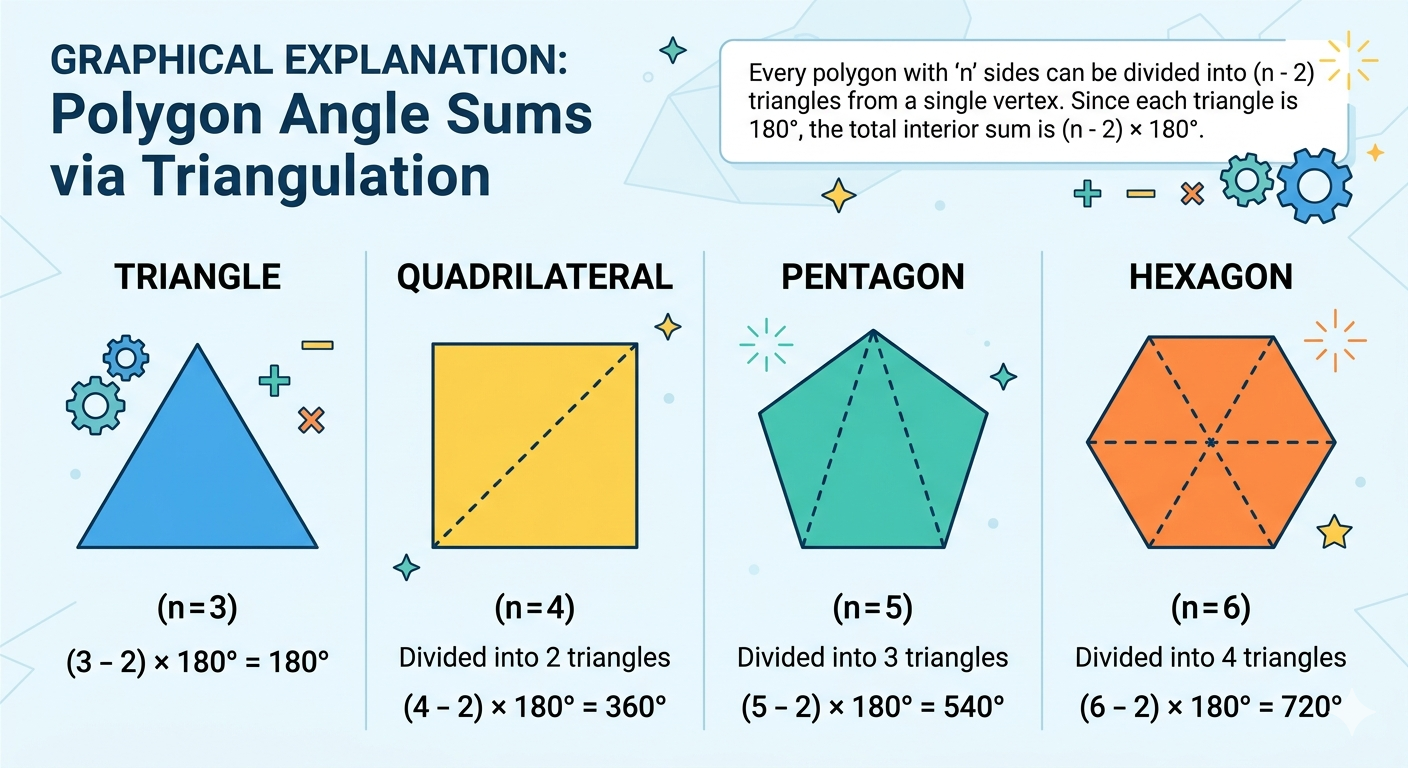
Graphical illustration showing triangulation of different polygons (triangle, quadrilateral, pentagon, hexagon) and their resulting angle sum calculations.
Figure 1: How any n-sided polygon is divided into (n-2) triangles from one vertex. This principle generates the total interior angle sum.

This leads to the fundamental formula:

Total Interior Sum (S) = (n - 2) × 180°

Where n is the number of sides of the polygon.

2. Worked Example: Finding a Missing Angle

Problem: A pentagon has four interior angles measuring 100°, 110°, 120°, and 80°. What is the measure of the fifth angle (x)?

  1. Step 1: Find the total sum.
    A pentagon has 5 sides (n=5).
    Sum = (5 - 2) × 180 = 3 × 180 = 540°.
  2. Step 2: Add the known angles.
    100 + 110 + 120 + 80 = 410°.
  3. Step 3: Subtract from the total.
    540 - 410 = 130°.

Result: The missing fifth angle is 130°.

3. Interactive Quiz (10 Questions)

Test your knowledge! Select the best answer for each question. Your answers will be validated when you click 'Check My Answers'.